
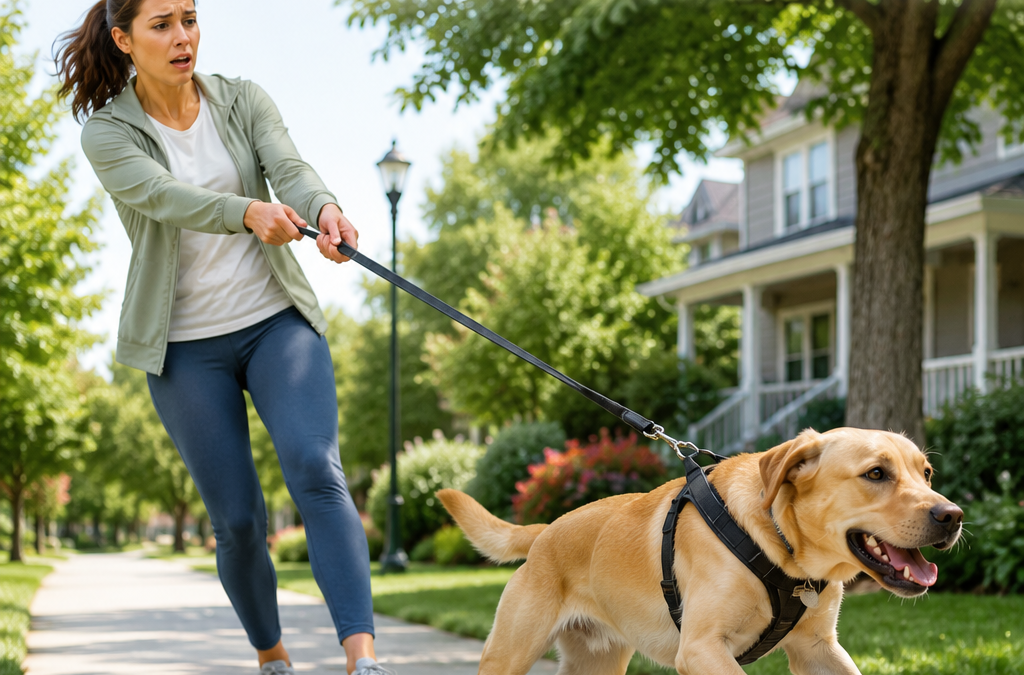
Chapter 1: Pulling on Leash
Pulling on leash is one of the most common problems dog owners face. It can turn a simple walk into a battle. The dog pulls forward. The owner pulls back. The dog pulls harder. The owner gets frustrated. Soon, the walk is no longer relaxing for either one of them.
The important thing to understand is this: most dogs do not pull because they are trying to be dominant, stubborn, or disrespectful. Dogs pull because pulling works.
When a dog pulls toward a smell, another dog, a person, a bush, a doorway, or an interesting patch of dirt, the dog often gets closer to what it wants. That reward teaches the dog to pull again. Every step forward on a tight leash can accidentally train the dog that pressure on the collar or harness means, “Keep going.”
Loose-leash walking must be taught. It is not natural for most dogs to walk slowly beside a human in a straight line while ignoring smells, movement, sounds, animals, and people. Humans walk for distance. Dogs walk for information. To a dog, the world is written in scent.
A good walk should teach the dog that a loose leash makes the world open, while a tight leash makes forward movement stop.
Why Dogs Pull on Leash
Dogs pull for several reasons. Some dogs pull because they are excited. Some pull because they are anxious. Some pull because they have never been taught another way to walk. Some pull because they have been allowed to rehearse pulling hundreds of times.
A dog may pull because:
- The dog wants to reach a smell.
- The dog wants to greet another dog.
- The dog wants to chase movement.
- The dog is excited to leave the house.
- The dog has too much energy.
- The dog is nervous and wants distance.
- The dog is frustrated by restraint.
- The dog has learned that pulling gets the dog where the dog wants to go.
- The dog has not been rewarded enough for walking near the owner.
- The dog does not understand leash pressure.
- The equipment is uncomfortable.
- The owner walks too fast, too slow, or inconsistently.
- The dog is over-aroused before the walk begins.
Pulling is not one single behavior. It is often a mixture of excitement, habit, reinforcement, instinct, frustration, and poor communication.
The Brain Chemistry Behind Pulling
To stop leash pulling, it helps to understand what is happening inside the dog’s brain and body.
When a dog sees something exciting, the dog’s nervous system becomes activated. The dog brain notices a possible reward: a squirrel, another dog, a person, a smell, or freedom to move. The reward system becomes more active. Dopamine plays an important role in motivation and reward-seeking. Dopamine does not simply mean “pleasure.” It helps drive the dog to pursue something valuable.
That is why a dog may suddenly surge forward when the dog sees a rabbit or smells something interesting. The dog’s brain says, “Go get that.”
At the same time, norepinephrine can increase alertness and focus. The dog becomes more awake, more intense, and more locked onto the target. The dog body prepares for action. The dog’s muscles tighten. The dog’s breathing may change. The dog’s ears may come forward. The dog‘s eyes may fix on the thing the dog wants.
If the dog is excited, frustrated, or stressed, adrenaline can increase physical energy. The dog may feel powerful, fast, and ready to move. If the situation continues or becomes stressful, cortisol may rise. Cortisol is part of the stress system. A little stress can help the body respond, but too much stress makes learning harder. A highly stressed dog may not think clearly and react instead of learn.
This is why yelling, yanking, or harsh corrections often make leash pulling worse. They may increase stress chemistry. The dog becomes more aroused, more frustrated, or more defensive. Instead of learning, “Walk calmly beside me,” the dog learns, “Walks are tense, confusing, and unpleasant.”
The goal is to lower arousal enough for the thinking brain to work.
A calm dog can learn. An over-aroused dog can only react.
Why Pulling Becomes a Habit
Pulling becomes strong because it is self-rewarding.
- If the dog pulls and reaches the tree, pulling works.
- If the dog pulls and gets to greet another dog, pulling works.
- If the dog pulls and moves down the trail faster, pulling works.
- If the dog pulls and the owner follows, pulling works.
The dog does not need to be rewarded with food for pulling. The environment rewards the dog. Movement rewards the dog. Smells reward the dog. Access rewards the dog.
That is why leash training must control access to rewards. The dog should learn:
- Loose leash = we move forward.
- Tight leash = forward movement stops.
- Attention to owner = rewards happen.
- Pulling = does not get the dog what it wants.
The Main Rule
The main rule is simple:
Never let pulling get the dog where the dog wants to go.
This does not mean punishing the dog. It means removing the reward for pulling. If the leash gets tight, stop. Wait. Let the dog think. When the dog softens the leash, looks back, turns toward you, or steps back into position, mark and reward. Then move forward again.
The dog learns through consequences. Loose leash opens the walk and a tight leash pauses the walk.
Equipment That Helps
The right equipment does not train the dog by itself, but it can make training safer and easier.
Recommended equipment:
- A six-foot leash or a slip lead
- A well-fitted flat collar or martingale collar
- A front-clip harness for strong pullers
- A treat pouch
- Small, soft high valued treats
- Comfortable walking shoes for the owner
For some dogs, a front-clip harness can reduce the power of pulling because it turns the dog’s chest slightly when the dog surges forward. However, the harness is only a management tool. The dog still needs training.
Avoid relying on tools alone. A dog can learn to pull through almost anything if the behavior keeps working.
Before the Walk: Calm Starts Inside
Many leash problems begin before the dog ever leaves the house.
If the dog explodes when the dog sees the leash, jumps at the door, barks, spins, and rushes outside, the dog’s brain is already in a high-arousal state. By the time the walk begins, the dog is not thinking. The dog is launching.
Start training before the door opens.
Step 1: Pick Up the Leash Calmly
Pick up the leash. If the dog jumps, barks, spins, or bites at the leash, stand still. Do not scold. Do not chase. Do not clip the leash.
Wait for one second of calm.
Mark it with “Yes.” Then reward.
Repeat until the dog understands that calm behavior makes the leash get attached.
Step 2: Clip the Leash on Calmly
Ask for a sit or stand. Clip the leash on. If the dog explodes, stop. Wait. When the dog relaxes, mark and reward.
Do not open the door while the dog is pulling toward it.
Step 3: Teach Doorway Control
Stand at the door. Put your hand on the knob. If the dog surges forward, remove your hand from the knob and wait.
When the dog steps back, looks at you, or relaxes, mark and reward.
Open the door slightly. If the dog rushes, close it.
Open the door again. If the dog stays calm, mark and reward.
The lesson is clear:
Calm behavior opens doors.
Rushing closes doors.
Foundation Skill: Follow Me
Before asking a dog to walk politely through a busy neighborhood, teach the dog that staying near you pays.
Start in a quiet room, hallway, yard, or driveway.
Step-by-Step: Follow Me
- Put the dog on leash.
- Hold treats in your pouch or pocket.
- Say, “Let’s go.”
- Take three steps.
- When the dog follows you, mark with “Yes.”
- Reward by your leg.
- Turn and walk the other way.
- Mark and reward when the dog catches up.
- Repeat for two to three minutes.
- Take a break and start over again until the dog grasps the lesson.
Do not worry about perfect heel position at first. The goal is simple: the dog learns that moving with you is valuable.
Reward near your leg or where you want the dog to be. If you reward in front of your body, you may accidentally teach the dog to forge ahead. Be careful about the position and consider what it means to the dog.
Foundation Skill: The Leash Pressure Game
Many dogs pull harder when they feel pressure. They do not understand that giving in to pressure makes the pressure stop. You must teach this gently.
Step-by-Step: Yield to Leash Pressure
- Stand in a quiet area.
- Let the dog stand near you.
- Apply the lightest possible leash pressure to one side.
- Do not yank.
- Wait for the dog to turn the dog head, shift weight, or step toward the pressure.
- The moment the dog gives in, mark with “Yes.”
- Reward.
- Repeat in both directions.
- Practice forward, left, right, and backward.
- Keep sessions short, no more than 5 minutes.
The dog should learn that softening leash pressure makes good things happen. This turns the leash from a restraint into a communication tool.
Step-by-Step Program to Stop Leash Pulling
This program builds behavior in layers. Do not rush. A dog that has pulled for years will not become perfect in one walk. Progress comes from repetition. Sometimes it can take hundreds of repetitions.
Step 1: Start in a Low-Distraction Area
Begin where the dog can succeed.
Good starting places:
- Living room
- Hallway
- Backyard
- Driveway
- Empty parking lot
- Quiet sidewalk
- Calm field
Bad starting places:
- Busy parks
- Pet stores
- Dog events
- School pickup areas
- Trails full of wildlife
- Neighborhoods with loose dogs
- Places where the dog is already over-aroused
Training should begin below the dog’s excitement threshold. If the dog is exploding, lunging, screaming, or dragging you, the environment is too hard.
Step 2: Reward Position
Stand with the dog near your left or right side. Choose one side for consistency.
- Say, “Let’s go.”
- Take a few steps.
- If the leash stays loose, mark with “Yes” and reward beside your leg.
- Continue walking.
- At first, reward often. Every few steps is fine. You are building a new habit.
Do not be stingy in the beginning. A dog that has practiced pulling needs a strong reason to choose a new behavior.
Step 3: Stop When the Leash Gets Tight
The moment the leash tightens, stop walking.
Do not pull the dog back. And do not say “No” repeatedly. Try not to use language during this exercise, the dog will learn quicker.
Simply become still.
Wait for the dog to make a better choice. The dog may look back. The dog may step toward you. The dog may loosen the leash by shifting the dog weight. The instant the leash softens, mark and reward.
Then continue walking.
This teaches the dog that pulling does not move the walk forward.
Step 4: Change Direction
If the dog repeatedly pulls ahead, use direction changes.
When the dog starts to forge ahead, cheerfully say, “Here,” and turn around.
Reward when the dog catches up and returns to your side.
Direction changes teach the dog to pay attention to your movement. They also prevent the dog from locking onto one target and dragging you toward it.
Keep the tone upbeat. This is not punishment. It is information.
Step 5: Use Life Rewards
Food is useful, but the environment is often more powerful. Use what the dog wants as a reward.
If the dog wants to sniff a bush, ask for a few steps of loose-leash walking first. Then say, “Sniff,” and walk the dog to the bush.
If the dog wants to move forward, reward loose-leash walking by moving forward.
This teaches the dog that polite behavior gives access to the world.
Step 6: Teach a Sniff Cue
Dogs need to sniff. Sniffing is not bad behavior. It lowers stress, provides information, and gives the walk meaning.
The problem is not sniffing. The problem is dragging the owner from smell to smell.
Teach a cue:
“Sniff.”
Walk the dog to an appropriate spot on a loose leash. Let the dog sniff for a short time. Then say, “Let’s go,” and move on.
Now the walk has structure.
The dog learns when sniffing is allowed and when moving with the owner is expected.
Step 7: Practice Check-Ins
A check-in is when the dog voluntarily looks back at you.
Check-ins are valuable because they show the dog is mentally connected to the handler. Whenever the dog looks at you during a walk, mark and reward.
At first, reward every check-in.
A dog that checks in often is easier to guide, redirect, and manage.
Step 8: Add Distractions Slowly
Once the dog walks well in quiet places, add distractions one at a time.
Start with mild distractions:
- A quiet street
- A person far away
- A parked car
- A calm dog at a distance
- A bird in the yard
- A low-traffic trail
Do not jump from the driveway to a crowded park.
Distance matters. If the dog can see another dog at 100 feet and still eat, think, and respond, work there. If the dog cannot respond at 20 feet, that is too close.
Training succeeds when the dog is challenged but not overwhelmed.
Step 9: Use the “Find It” Reset
For dogs that get too excited, teach a reset cue.
Say, “Find it,” and toss a treat on the ground near your feet.
The dog lowers the dog head and sniffs for the treat. This can interrupt fixation, lower intensity, and bring the dog brain back to the handler.
Use this before the dog explodes, not after the dog is already out of control.
Step 10: End Before the Dog Fails
Short, successful walks are better than long, chaotic walks.
A five-minute calm training walk teaches more than a thirty-minute pulling battle.
End the session while the dog is still doing well. Go back inside. Let the dog rest. Repeat later.
Training is not about exhausting the dog. It is about building the right pattern.
The Red Light / Green Light Method
This is one of the simplest ways to teach loose-leash walking. Green light means the leash is loose and you move forward. Red light means the leash is tight and you stop.
How to Do It
- Start walking.
- If the leash is loose, keep moving.
- If the leash gets tight, stop immediately.
- Wait silently.
- When the dog loosens the leash, mark and reward.
- Walk forward again.
The timing must be clear. If the dog pulls for ten feet before you stop, the dog was rewarded for pulling those ten feet. Stop the moment the leash tightens.
The Turn-Around Method
This method helps dogs that charge ahead.
How to Do It
- Walk forward.
- When the dog gets ahead and the leash begins to tighten, say, “This way.”
- Turn and walk in the opposite direction.
- Reward the dog when the dog catches up.
- Repeat often.
This teaches the dog that paying attention matters. The handler becomes relevant again.
The Penalty Yard Method
This method is useful when the dog pulls toward something the dog wants.
How to Do It
- Let the dog notice the thing the dog wants.
- Walk toward it only while the leash is loose. If the dog pulls, calmly turn and walk several steps away.
- Wait for the dog to calm.
- Try again.
- Continue until the dog reaches the reward on a loose leash.
This teaches that pulling makes the reward farther away, while self-control makes the reward closer.
Use this for:
- Sniff spots
- Doors
- Gates
- Cars
- People
- Play areas
- Favorite trees
Training Plan: Seven Days to Better Leash Walking
This plan will not make every dog perfect in seven days, but it will create a clear foundation.
| Day | Goal | Exercise |
| Day 1 | Calm leash handling | Practice picking up the leash, clipping it on, and opening doors calmly. |
| Day 2 | Follow me | Practice short indoor or backyard walking sessions with rewards at your side. |
| Day 3 | Yield to leash pressure | Teach the dog to soften and move with gentle leash pressure. |
| Day 4 | Stop when leash tightens | Use the red light / green light method in a quiet area. |
| Day 5 | Direction changes | Add “This way” turns before the dog hits the end of the leash. |
| Day 6 | Sniff cue | Reward loose walking with “Go sniff” breaks. |
| Day 7 | Mild distractions | Practice around low-level distractions at a distance the dog can handle. |
Repeat this weekly, slowly increasing difficulty.
Right Things to Do
| Right Thing | Why It Works |
| Start in low-distraction places | The dog can think and succeed. |
| Reward beside your leg | The dog learns where to be. |
| Stop when the leash gets tight | Pulling no longer works. |
| Move forward when the leash is loose | Loose leash becomes rewarding. |
| Use food and life rewards | The dog earns both treats and access to the world. |
| Teach “Go sniff” | The dog gets a natural outlet in a controlled way. |
| Practice short sessions | Prevents frustration and fatigue. |
| Change direction calmly | Keeps the dog connected to you. |
| Reward check-ins | Builds attention without nagging. |
| Stay consistent | Dogs learn patterns through repetition. |
| Lower the difficulty when needed | Prevents failure and over-arousal. |
| Use calm body language | Helps keep the dog’s nervous system settled. |
| Train before the walk begins | Prevents the dog from launching out the door. |
Wrong Things to Do
| Wrong Thing | Why It Causes Problems |
| Let the dog pull to everything the dog wants | This rewards pulling. |
| Yank the leash repeatedly | This can increase stress, frustration, and resistance. |
| Drag the dog backward | The dog may fight pressure harder. |
| Yell at the dog | Yelling adds arousal and confusion. |
| Train only in hard environments | The dog fails because the distraction level is too high. |
| Reward in front of your body | This may teach the dog to forge ahead. |
| Walk when the leash is tight | The dog learns tight leash means forward movement. |
| Expect perfect walks too soon | Loose-leash walking takes repetition. |
| Use walks only for exercise | Dogs also need training, sniffing, and mental work. |
| Ignore emotional state | Fear, anxiety, and stress must be addressed separately. |
| Use equipment as a substitute for training | Tools manage behavior but do not teach by themselves. |
| Allow greetings while pulling | The dog learns to drag you toward people or dogs. |
Common Mistakes Owners Make
Mistake 1: Waiting Too Long to Stop
If the dog pulls for ten steps and then the owner stops, the dog was rewarded for ten steps of pulling. Stop as soon as the leash tightens.
Mistake 2: Moving Too Fast
Many owners start in a busy neighborhood, then wonder why the dog cannot focus. Begin in easy places. Build success.
Mistake 3: Talking Too Much
Repeating “heel, stop, no, slow down, come on, leave it” can become background noise. Use fewer words and clearer consequences.
Mistake 4: Not Rewarding Enough
Owners often correct pulling but forget to reward good walking. The dog needs to know what behavior pays.
Mistake 5: Making Every Walk a Training Battle
Some walks should be structured training walks. Other outings can be decompression walks on a longer line in safe areas. Dogs need both discipline and freedom.
Special Notes for Rescue Dogs
Rescue dogs may pull for different reasons. Some have never been leash trained. Some are nervous in new environments. Some are desperate to sniff because the world feels unfamiliar. Some have learned that moving fast helps them escape pressure.
With rescue dogs, go slower.
Use quiet routes and reward often.
Avoid busy dog parks, crowded sidewalks, and chaotic events until the dog has confidence.
If the dog is fearful, do not force the dog to walk close to scary things. Increase distance and reward calm observation.
For nervous dogs, the goal is not military-style obedience. The goal is safety, trust, and confidence.
Special Notes for Strong Dogs
Large, powerful dogs need early leash structure because physical strength can become a safety issue.
- Use good equipment.
- Practice in controlled areas.
- Reward heavily for position.
Do not allow the dog to rehearse dragging you.
If needed, use a front-clip harness attached with a safety backup to a collar. The goal is not to overpower the dog. The goal is to prevent injury while training better choices.
Special Notes for High-Drive Dogs
High-drive dogs may pull because movement and scent are intensely rewarding. These dogs often need more than a slow sidewalk walk.
Add structured outlets:
- Tracking games
- Scent work
- Tug with rules
- Fetch with impulse control
- Long-line decompression walks
- Obedience games
- Place work before walks
- Calm doorway drills
A high-drive dog does not need less structure. The dog needs more intelligent structure.
When Pulling Is Actually Reactivity
Some dogs are not simply pulling. They are reacting.
Signs of reactivity include:
- Barking
- Lunging
- Growling
- Screaming
- Spinning
- Stiff body
- Hard staring
- Hackles raised
- Inability to take food
- Explosive response to dogs, people, bikes, cars, or wildlife
If the dog is reactive, loose-leash walking alone is not enough. The emotional response must be addressed. The dog needs distance, counterconditioning, desensitization, and careful management.
Do not force a reactive dog into close contact. That can make the problem worse.
Troubleshooting
Problem: My dog pulls harder when I stop.
Wait quietly. The moment the dog softens the leash, mark and reward. If the dog cannot calm down, the environment is too exciting. Move to an easier place.
Problem: My dog ignores treats outside.
The dog may be over threshold or stressed. Increase distance from distractions. Use better food. Practice in easier locations. A stressed dog will not eat.
Problem: My dog walks nicely after ten minutes but pulls at the start.
Train the first two minutes of the walk. Do not let the dog explode out the door. Practice calm leash clipping, doorway control, and short back-and-forth walking before leaving the property.
Problem: My dog only pulls toward other dogs.
Stop allowing leash greetings while pulling. Work at a distance where your dog can still think. Reward check-ins. Teach “Let’s go” and move away before the dog locks on.
Problem: My dog pulls toward smells.
Use sniffing as a reward. Ask for loose leash first, then cue “Sniff.” Do not let the dog drag you from smell to smell.
Problem: My dog walks well with the trainer but not with me.
Dogs learn patterns with specific people. The trainer may have better timing and consistency. Practice the same rules every day. Reward more often. Stop sooner. Be clearer. Leash training does not transfer from one handler to another.
Sample Training Session
Here is a simple ten-minute session:
- Clip the leash on calmly.
- Practice doorway control for one minute.
- Walk in the driveway.
- Reward every few steps near your leg.
- Stop when the leash tightens.
- Mark and reward when the dog softens.
- Change direction five times.
- Walk toward a sniff spot.
- If the leash stays loose, say, “Go sniff.”
- End before the dog becomes wild or frustrated.
This session is short, clear, and effective.
The Goal Is Not a Robot Dog
Loose-leash walking does not mean the dog must stare at you every second. The goal is to have a dog who can walk with you, notice the world, sniff when released, and respond when guided.
A good leash walk has balance.
The dog gets freedom and the owner has control, while the leash stays soft. This enhances the relationship between owner and dog.
Great Article